
World War II was a global conflict that lasted from 1939 to 1945, involving most of the world’s nations. It was triggered by the aggressive expansionist policies of Nazi Germany, led by Adolf Hitler, and imperial Japan, among other factors. The war had a profound impact on Poland, which was one of the first countries to be invaded and occupied by Nazi Germany.
Here is a brief history of World War II and its effects on Poland:
Prelude to War:
- In 1933, Adolf Hitler came to power in Germany and began aggressively pursuing territorial expansion.
- In 1938, Nazi Germany annexed Austria (Anschluss) and demanded the Sudetenland from Czechoslovakia, which was appeased through the Munich Agreement.
- In August 1939, Germany signed the Molotov-Ribbentrop Pact with the Soviet Union, a non-aggression treaty that also contained a secret protocol dividing Eastern Europe into spheres of influence.
Invasion of Poland (September 1939):
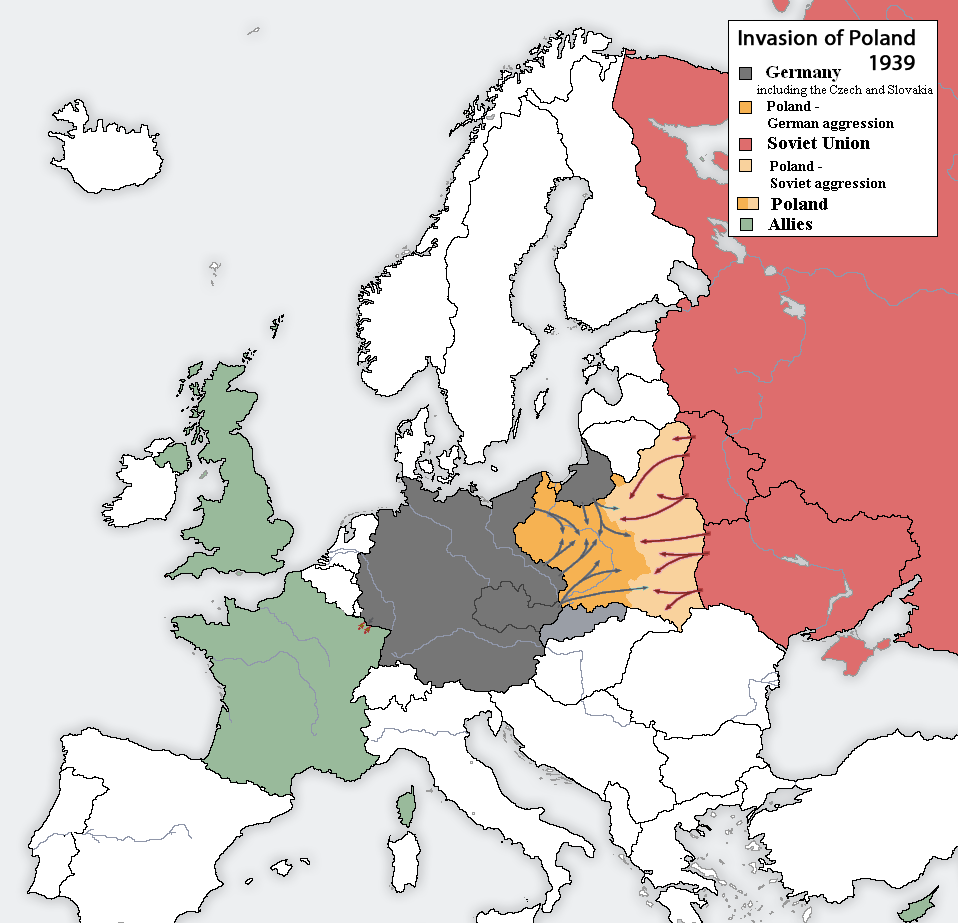
- On September 1, 1939, Germany launched a full-scale invasion of Poland.
- On September 17, the Soviet Union also invaded Poland from the east, in accordance with the secret protocol of the Molotov-Ribbentrop Pact.
- The Polish armed forces were overwhelmed, and the country quickly fell to the invaders.
Occupation and Resistance:
- Poland was divided into German-occupied and Soviet-occupied zones.
- The Nazis implemented a brutal occupation, carrying out mass executions, forced labor, and the establishment of concentration and extermination camps, such as Auschwitz.
- Despite the occupation, Polish resistance movements, including the Home Army (Armia Krajowa), continued to fight against the occupiers through acts of sabotage and underground activities.
Wartime Poland:
- Millions of Poles were killed during the war, both as a result of military action and the Holocaust.
- The Warsaw Ghetto Uprising in 1943 and the Warsaw Uprising in 1944 were significant acts of resistance by the Polish population against Nazi oppression.
- Poland’s major cities and infrastructure were heavily damaged during the conflict.
End of the War:
- World War II ended in 1945 with the unconditional surrender of Germany in May and the dropping of atomic bombs on Hiroshima and Nagasaki, leading to Japan’s surrender in August.
- The Allied powers, including the Soviet Union and the Western Allies, played a pivotal role in defeating the Axis powers.
Post-War Poland:
- After the war, Poland’s borders were redrawn as part of the Yalta and Potsdam agreements, resulting in significant territorial changes.
- The country came under Soviet influence, leading to the establishment of a communist government in Poland.
- The effects of the war, including physical destruction and loss of life, had a lasting impact on Polish society and economy.
World War II had a devastating impact on Poland, which suffered from occupation, destruction, and loss of life during the conflict. After the war, Poland found itself in the sphere of Soviet influence and experienced significant political and social changes that lasted for decades. The war also had a profound and lasting effect on the country’s national consciousness and historical memory.
 Meticulous Meanderings
You must be logged in to post a comment.